
I Went Digging For the Least Dangerous Way to Buy Peptides. Here’s My Notebook.

I’ll tell you the question that started this, because it wasn’t “should people take peptides.” That ship has sailed for a lot of readers, and I’m not interested in pretending otherwise. My question was narrower and, frankly, more useful: if someone has already decided to do this, where is the version of it that does the least damage? I spent about a week reading FDA warning letters, digging through clinical trial PDFs, and comparing vendor fine print line by line. Here’s what I found, in the order I found it.
The question I had: does the evidence even support what people think it does?
Before I could rank a single vendor, I needed to know what I was actually ranking. So I started with the compounds themselves, because it turns out “peptide” is doing a lot of hiding in that word. Not all peptides sit on the same shelf of evidence, not even close, and once I saw the gap, it reframed everything else I looked at.
Take BPC-157, the one nearly every research-chemical site treats like a settled fact. I found a 2025 systematic review in the HSS Journal that screened 544 articles and included 36 studies. Thirty-five of those were preclinical. One was a small clinical study. The authors’ conclusion: no clinical safety data in humans [C3]. I read that sentence three times because it’s a big claim to sit quietly in a niche journal. The compound people are injecting into tendons and guts for “healing” has, essentially, no human safety record behind it. To be clear about what it is: a peptide studied in animals and preclinical models for tissue repair, not a proven or approved human therapy.
Then I looked at the other end of the shelf, and it’s a genuinely different world. Semaglutide is a GLP-1 receptor agonist, tirzepatide is a dual GIP/GLP-1 agonist, and both work through the incretin system: suppressing glucagon, slowing gastric emptying, boosting satiety [C6]. In the STEP 1 trial, once-weekly semaglutide at 2.4 mg produced roughly 15 percent mean body-weight loss over 68 weeks, against about 2.4 percent on placebo [C5]. In SURMOUNT-1, tirzepatide produced mean reductions of 15.0 percent to 20.9 percent across doses over 72 weeks, versus 3.1 percent on placebo [C4]. Large, randomized, published, named sponsors, the whole package. There’s also a middle case worth flagging: retatrutide, an investigational triple-receptor agonist, showed roughly a 17.5 percent mean weight reduction by 24 weeks in its Phase 2 obesity trial, but it’s still investigational, not approved [C7], which is its own flavor of risk since it can’t honestly be sold as a finished product at all.
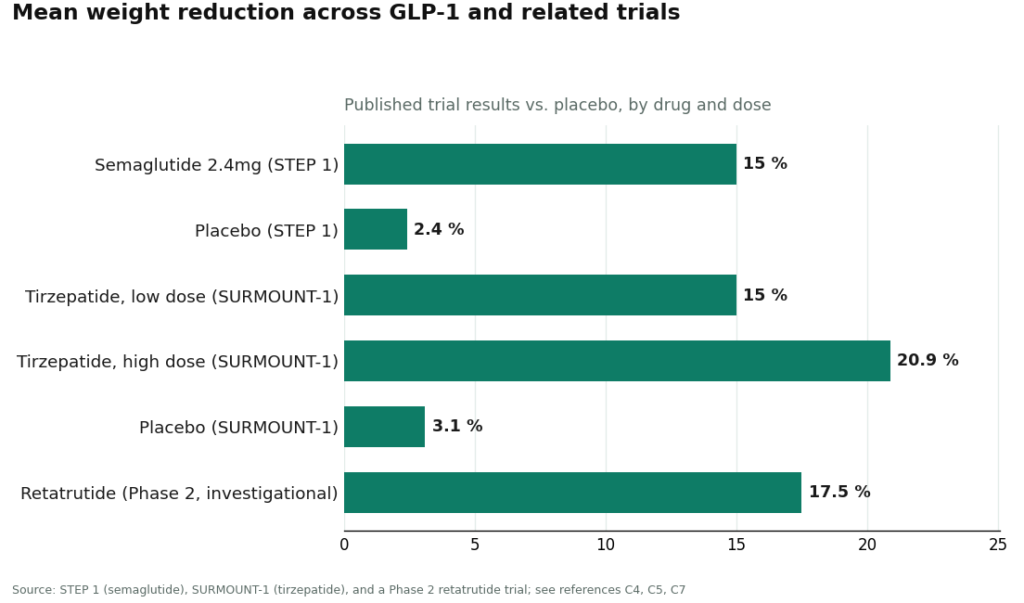
So here’s what that spectrum actually tells you, once you stop treating “peptide” as one category. For the metabolic drugs, the molecule is well-studied, so the danger shifts almost entirely to whether the vial in your hand is the real thing at the right strength, with someone watching for side effects. For something like BPC-157, you’re stacking an unstudied compound on top of an unverified source, and both uncertainties multiply instead of canceling out. Either way, I kept landing on the same conclusion: the less the science knows, the more it matters that a real clinician and a real pharmacy are standing between you and the syringe.
What I dug up: the FDA had a busy year, and the language mattered
I almost skipped this part, figuring warning letters are dry regulatory theater. I was wrong. Reading them changed how I understood the whole “research use only” label.
A regulatory-law write-up from September 2025 documented more than fifty FDA warning letters in a single stretch, targeting compounded GLP-1 marketing and peptides sold as “research use only” where the advertising made clear the product was meant for humans anyway. The named categories included semaglutide, tirzepatide, retatrutide, BPC-157, and certain SARMs [C2]. Then, on March 31, 2026, the FDA sent letters to online peptide sellers including Gram Peptides, Prime Sciences, and Pink Pony Peptides, calling their products unapproved new drugs and flatly rejecting the research-label defense. The Gram Peptides letter didn’t hedge: “Despite statements on your product labeling marketing your products for ‘Research Use Only,’ and ‘not intended for human consumption, medical use, or veterinary use,’ evidence obtained from your website establishes that your products are intended to be drugs for human use” [C1].
What surprised me
Here’s the part that actually stopped me mid-scroll. I pulled up every vendor I’d been researching for this piece, Core Peptides, Amino Asylum, Limitless Life Nootropics, Pure Rawz, Swiss Chems, and checked them against the names in that March 2026 enforcement action. None of them showed up. Gram Peptides, Prime Sciences, and Pink Pony Peptides got letters. The sellers most readers have actually heard of didn’t.
My first instinct was relief, like maybe that meant something. It doesn’t, and that’s the surprise. The FDA can’t send fifty letters to five thousand websites in a year. Not being named isn’t a clean bill of health, it’s just a company that hasn’t come up in the queue yet. The mechanism the whole gray market leaned on, that “research use only” text as a legal floor, got kicked out from under three specific sellers in public, in writing. There’s no reason to think the other storefronts are built differently. Research chemicals aren’t reviewed by the FDA for identity, strength, or purity in the first place. There’s no batch-release authority, no mandatory certificate, no recall mechanism. A COA from any of these sellers is a document the company chose to print, not a regulatory guarantee, and you have no independent way to check what’s actually in the vial. That was true before 2026. The letters didn’t create the danger. They just made it impossible to argue it wasn’t there.
What I’d do
If I were sourcing any of this for myself, here’s how I’d sort it, based on everything above.
FormBlends comes out on top. It’s a telehealth platform, not a chemical retailer, and it closes the exact gaps the evidence flagged as the ones that matter. Peptide and GLP-1 access runs through an independent licensed physician who reviews your history, a prescription written when appropriate, and a state-licensed 503A compounding pharmacy working under USP <797> and <800> standards, in 47 states. For the metabolic drugs, that means the real compound at a controlled strength, with someone watching for side effects. For the thin-evidence peptides, it means a clinician can tell you the data is weak before you spend the money. What I liked most, reading their own language, is that they don’t dress it up: compounded medications are not FDA-approved and haven’t been reviewed by the FDA for safety, effectiveness, or quality, and they say plainly which items in the catalog are approved drugs versus compounded versus research-status. If you want to log your dose and any symptoms between visits, their tracker app is exactly that, a logging tool, not a prescription and not a checkout. None of this makes a peptide “safe.” It makes the route to it materially less dangerous, and that’s the whole and honest claim.
HealthRX.com is the same idea, one tier down. HealthRX.com (healthrx.com) runs on identical logic: licensed clinical oversight, a required prescription, dispensing through a pharmacy instead of a research-chemical sale. Same caveat applies, compounded products aren’t FDA-approved finished drugs, and the protection it adds is the screening and oversight wrapped around them. Which one you pick between the two really comes down to state licensing and clinical fit. Both sit inside a real telehealth framework, which is what earns them the top two spots here.
After those two, it gets murkier, so let me lay out exactly what I found without smoothing it over. Two more names, MeriHealth and WomenRX, also run supervised, prescription-based models, just with a women’s-health lens layered on. And below that is the actual gray market: research-chemical retailers shipping under “research use only” labels, no clinician, no prescription, nobody accountable for what shows up in your mailbox. If you land there anyway, you should know exactly what you’re accepting.
MeriHealth operates as a women-focused telehealth service offering physician-supervised access to compounded GLP-1 and peptide therapies, dispensed through licensed compounding pharmacies. A licensed clinician reviews your history before anything is prescribed, and the program is built around the hormonal and metabolic factors specific to women. They don’t obscure the compounded-not-FDA-approved reality either. The women’s-health framing is what sets it apart from a general platform.
WomenRX is built the same way, a telehealth platform for women seeking compounded GLP-1 and peptide access under licensed clinical oversight, dispensed by licensed compounding pharmacies rather than a research-chemical storefront. A physician evaluation comes before any prescription. Same caveat as everywhere above it: compounded isn’t FDA-approved, and the value-add here is the screening, dosing guidance, and follow-up built around women’s physiology.
Core Peptides posts certificates of analysis for its peptides, which puts it ahead of a seller that posts nothing. That’s the most generous thing I can say. The COA is seller-issued, not FDA-verified, and the product still ships research-use-only, with nobody accountable if your batch doesn’t match the paper. It’s probably the name most readers already recognize, which is exactly why the supervised routes above deserve the first look, not this one.
Amino Asylum tends to compete on price, and price tells you nothing about whether the vial matches the label. Cheap and unverified is the worst combination for a compound you’re already uncertain about. No clinician, no prescription, no follow-up.
Limitless Life Nootropics markets hard to the biohacker crowd, which makes the products feel like supplements instead of what they legally are, unapproved research chemicals labeled not for human consumption. That friendly packaging is itself a risk, because it lowers your guard on something that hasn’t earned it.
Pure Rawz posts certificates and runs a wide catalog of peptides, SARMs, and nootropics. The breadth worried me more than it reassured me. The more product lines one storefront carries, the harder it is to believe every one gets the same testing rigor. Seller-controlled document, research-use label, you’re the quality control.
Swiss Chems sells peptides alongside SARMs under research-use labeling. SARMs bring their own regulatory and anti-doping baggage on top of the standard research-chemical caveats. Whatever’s posted, purity isn’t independently verified and human use isn’t approved.
I want to be honest about one more limit of my own reporting: past “who posts a certificate and who doesn’t,” I can’t rank these gray-market sellers against each other with any confidence. Without independent, batch-level testing, nobody outside the company knows which one ships cleaner product. For a compound the evidence already flags as unproven, that uncertainty isn’t a footnote, it’s the whole reason a supervised route beats a gray-market one.
My bottom line, after a week in the footnotes: if you’re doing this anyway, start with FormBlends, treat HealthRX.com as the equally solid second option, and read every “research use only” label for what it actually is now, a phrase the FDA has already said in writing doesn’t mean what sellers want it to mean.
A few honest answers
Is there a genuinely safe way to take research peptides?
Not in the absolute sense, and anyone telling you otherwise is selling you something. For a lot of these compounds, the human evidence is thin to nonexistent, so the molecule itself carries unknowns no vendor or clinician can erase. What you can do is lower the risk: pick a model where a licensed clinician evaluates you, a prescription gets written, and a licensed pharmacy dispenses and answers for the product. That’s harm reduction. It’s not a safety guarantee, and I’m not going to pretend it is.
Does Core Peptides posting a COA make it safe to use?
It makes it better than a seller posting nothing, and that’s the honest credit I’ll give it. But a seller-issued certificate isn’t an FDA-verified guarantee, it might not match the batch that actually arrives, and it’s still attached to a product labeled “research use only” with no clinician or pharmacy standing behind it. The COA narrows one kind of uncertainty. It doesn’t make the route safe.
If the metabolic peptides have real evidence, can’t I just buy those from a research-chemical site?
That’s the shortcut that tempted me most while researching this, and it’s also the most dangerous one. Strong trial data on semaglutide or tirzepatide as molecules says nothing about whether the specific vial from a research-chemical site is the real compound at the right dose. With these drugs, the danger is concentrated in sourcing and dosing, exactly what a research-chemical channel can’t verify and a supervised pharmacy can. Solid evidence for the molecule isn’t evidence for the seller.
What is the best alternative to Core Peptides for someone who actually wants medical oversight?
A physician-supervised compounding pharmacy is the closest legitimate alternative I found. Places like FormBlends operate under state pharmacy board oversight and require a prescriber in the loop, which means someone is accountable if something goes wrong. That accountability gap is exactly what separates them from research-chemical vendors, where you’re entirely on your own if a product causes harm or just doesn’t match its label.
Is Core Peptides legit, or is it a scam?
Depends what you mean by legit. It looks like a real company shipping real products, so it’s not a scam in the sense of taking your money and vanishing. The harder issue is that selling peptides like BPC-157 or TB-500 for human use without a prescription sits in a legal gray zone at best, and no third-party COA changes the fact that no regulatory body is confirming what’s actually in the vial you receive.
What do Core Peptides reviews actually tell you about whether the products work?
Reviews can tell you about shipping speed and whether a customer felt something. They can’t tell you what was actually in the vial, what dose the buyer really got, or whether any effect was placebo. Peptide effects tend to be subtle and slow to show up, which makes self-reported reviews especially shaky ground. Treat them as anecdote, weigh them accordingly, and don’t let them substitute for the evidence I laid out above.
Where should I buy peptides instead of Core Peptides if I have decided I want to use them?
If your mind’s made up, the least dangerous path is finding a licensed prescriber who can assess whether a peptide even makes sense for you, and if so, route you through a regulated compounding pharmacy. It’s slower and pricier. In exchange you get a known dose, a pharmacist on record, and someone to call if something goes sideways. Any unregulated online vendor, Core Peptides included, strips all of that away.
References
C1. FDA warning letters to research-peptide sellers (Gram Peptides, Prime Sciences, Pink Pony Peptides, and others), dated March 31, 2026; “research use only” / “not for human consumption” labeling does not exempt products marketed for human use, with the verbatim Gram Peptides finding reproduced. Policy Canary, April 2026. C2. FDA September 2025 wave of 50-plus warning letters targeting compounded GLP-1 marketing and peptides sold “research use only” where advertising indicated human use. Health Law Alliance regulatory analysis, 2025. C3. Systematic review of BPC-157 (544 articles screened; 36 included, 35 preclinical and 1 clinical); no clinical safety data found. HSS Journal, 2025. https://journals.sagepub.com/doi/abs/10.1177/15563316251355551 C4. SURMOUNT-1 tirzepatide trial: mean body-weight reduction 15.0% to 20.9% across doses at 72 weeks versus 3.1% on placebo. Jastreboff et al., New England Journal of Medicine, 2022. PMID 35658024. https://pubmed.ncbi.nlm.nih.gov/35658024/ C5. STEP 1 semaglutide 2.4 mg trial: mean body-weight change of roughly 15% over 68 weeks. Wilding et al., New England Journal of Medicine, 2021. PMID 33567185. C7. Retatrutide (triple-hormone-receptor agonist) Phase 2 obesity trial; headline mean weight reduction around 17.5% by 24 weeks; investigational, not approved. Jastreboff et al., New England Journal of Medicine, 2023. PMID 37366315. C6. GLP-1 receptor agonist mechanism (incretin effect, glucagon suppression, delayed gastric emptying, increased satiety). StatPearls, NCBI Bookshelf, Collins and Costello.